Can you make a performance inside your life. Is your life inside the performance. Is there time to work. Is there anything other than work to do. Apparently I don’t think of these as questions — I’ve not included question marks.
Do you make a performance inside your life? I do.
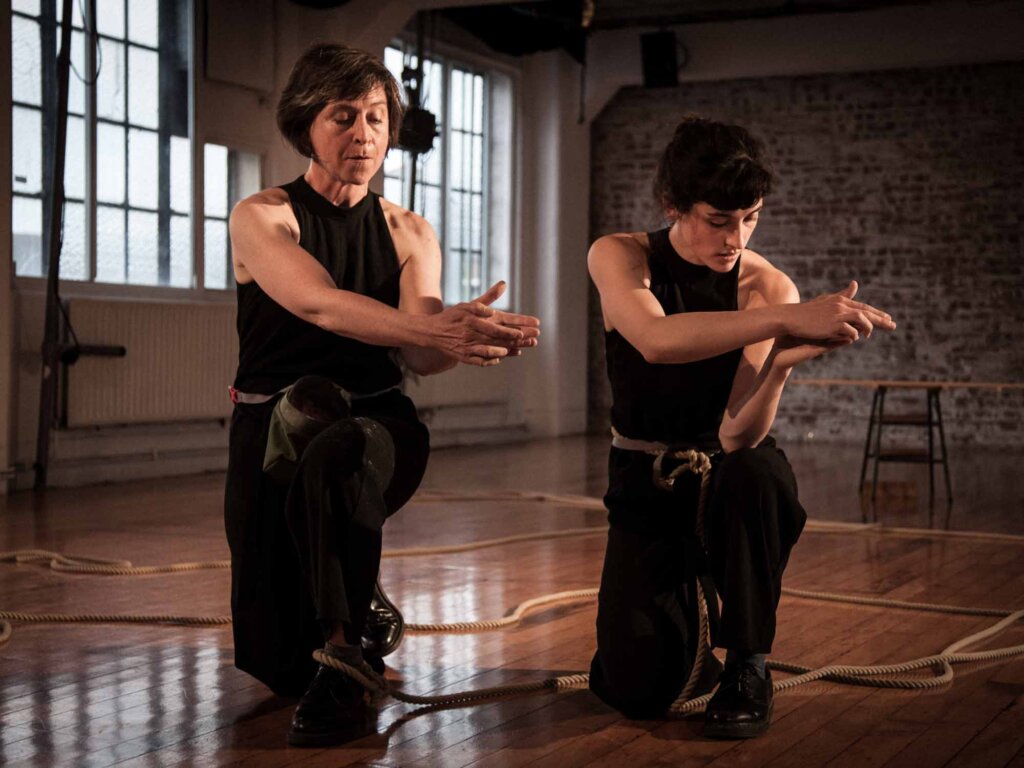
I went to Copenhagen to work with Sophie Grodin to make a 30-minute performance within a 10-day period, in a total of 50 hours. Practicalities intervened including: eating, sleeping, an all-day hen party, other people’s shows, making coffee, shopping for food or for a clothes line, hauling the roller skates out of the attic, getting lost, conversations with the people subletting the space to us, reading bedtime stories to an almost six-year-old child, washing the dishes, sitting in the park, carrying the cargo bike battery up 5 flights of stairs, singing to the busiest road in Copenhagen even though they couldn’t possibly hear us through these windows, speaking with or writing to our significant others.
Everything we do makes the work. That is always the answer to the question, whether or not it has actually been asked.
Starting from barely a spark of an idea—albeit one we’d been mulling over for the past 2 years in different scents and textures from far apart in two different countries—a kind of jolting, start-stop action in communication, relationships, social media, lifestyle, disagreements, and a counter-factual circumnavigation of truthiness. The judder of life and the demand of position.
In a position of rejection from every residency or funding opportunity we applied for, we considered shortening the time it takes to make the work. Could our collaboration go faster than it usually does? I never thought so. The process needs time for the interventions of life, those that slow it down and those that feed into it. We tried it and this is what I found: You make the performance you can in the time you have—something I used to tell my students. In this case I told myself by doing it. The piece was not ready, we were not ready—not ready to do a perfectly planned “correct” version. But the piece we did do breathed and flexed and together we invented a new version in front of the audience by turning half of the plan into an improvisation about how to get back to where we wanted to be when we forgot what came next (otherwise known as losing our way and finding another way).
A quick description of the hole we fell in: we had employed a timing device, a sound track that kicked in at the halfway point of our allotted time within a busy festival schedule. The sound track signalled shifts of material within the second half and marked the end of the performance; a remedy for those who have plotted a score with no time to run it. Our timing device included two minutes of silence during which we would be singing a song without accompaniment.
But I get ahead of myself. Sometime during the first half we sang a song in the wrong position. By that I mean at a position in the sequence different from what we had planned. Does this sound confusing? Imagine material flowing out of us and all making as much sense as it should until we get to the point in the recipe where a sauce should be ready to add to the food in the frying pan but, not having read the whole recipe before starting, we had not prepared one in advance. What I’m saying is, sitting at the edge of the frying pan, we found ourselves falling in.
The song went like this (try to hear it with a sweet/melancholy melody):
When the wind blows, when the flood comes, when the fire burns,
when the earth opens up and lava oozes out or shoots into the sky . . . .
what will matter more, what will matter more, what will matter more . . . ?
This song line repeated over and over as we swayed side to side shoulder to shoulder looking out toward the viewers. But it was too early. It felt too early and it was too early. Nevertheless we sang it and we meant it.
When the silence in the soundtrack arrived, the realisation that this is where the song was supposed to happen hit us, and it knocked the wind out of us. Not only would this have been a better place for the song to be heard, but what are we going to do now? Momentarily we were stumped. Having done it once we couldn’t really do it again. Very repetitive. And not enough time had passed. Well, there were probably two solutions though—as I write this—I can think of two more and then—if I stopped writing this—I realise I could come up with an almost endless number of other solutions to this two-minute silence and make of these a completely different performance that might be just as good but very very different. The first two options were: 1. repeat the simple and repetitive song and 2. make a new song for the rapidly diminishing hole in our sequence.
We made a new song. First, in a glib conversation, in front of the audience, on the dilemma we faced, followed by words from an earlier text we had not found space for, finding the melody line by line alternating between the two of us. Listening and then responding. We smiled. The audience laughed. It was funny. Funny partly because we were doing it. Singing our way out of an openly confessed problem of our own making. That is probably the most elegant description of what we do in the best of times.
That show will never be seen again. We couldn’t do it if we tried.
Here’s a review of Two Apart (in Danish) which was performed at Tårnby Park Festival 2025 (Legeland)
Photos above by Max Morris-Doherty